


Introduction
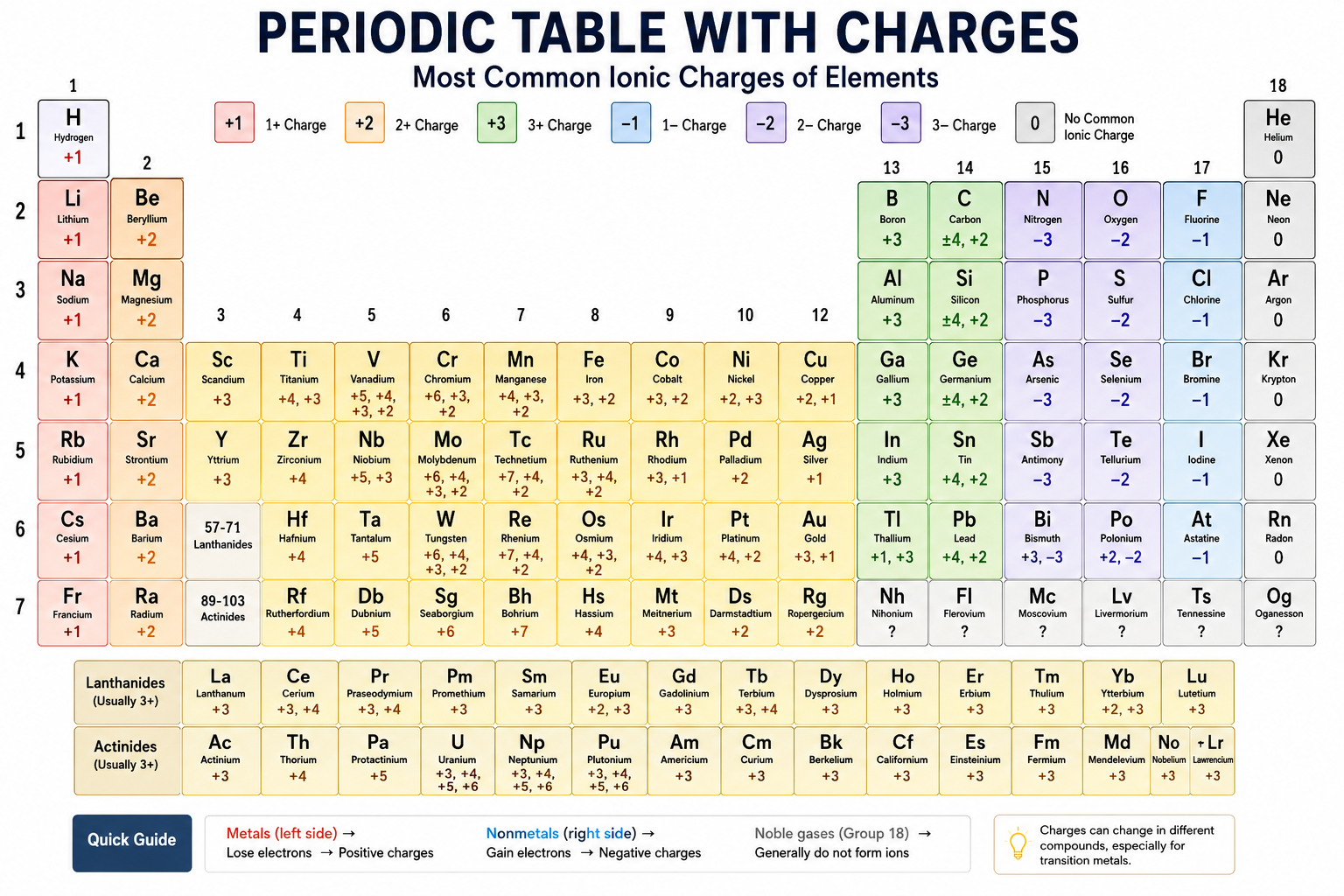
The periodic table with charges is one of the most useful learning tools for students studying chemistry. While the standard periodic table shows the symbols, atomic numbers, and atomic masses of elements, a periodic table with charges also displays the most common ionic charges that elements form. This extra information makes it much easier to predict chemical formulas, understand ionic bonding, and solve chemistry problems.
Whether you’re a high school student, a college learner, or simply interested in chemistry, understanding the charges of elements is essential. Ionic charges explain how atoms gain or lose electrons to become stable, and they help determine how different elements combine to form compounds.
In this guide, we’ll explore what a periodic table with charges is, why it’s important, how to read it, and the common charges of different groups of elements.
What Is a Periodic Table with Charges?
A periodic table with charges is a modified version of the standard periodic table that includes the most common oxidation states or ionic charges for each element. These charges indicate how many electrons an atom tends to gain or lose when forming ions.
Unlike atomic number or atomic mass, ionic charges are not always the same for every element. Some elements have one common charge, while transition metals can have multiple possible charges depending on the chemical compound they form.
Students often use a periodic table with charges because it provides a quick reference when writing chemical formulas, balancing equations, or identifying ionic compounds in chemistry classes.
Why Element Charges Matter
Element charges play a crucial role in chemical reactions. Atoms naturally seek stable electron arrangements, and gaining or losing electrons helps them achieve that stability. This process results in positively or negatively charged ions.
When opposite charges attract, ionic compounds form. For example, sodium loses one electron to become a +1 ion, while chlorine gains one electron to become a -1 ion. Their opposite charges allow them to combine and form sodium chloride (table salt).
Using a periodic table with charges makes these relationships much easier to understand because students can quickly identify which elements commonly form positive or negative ions.
Understanding Common Group Charges
One of the easiest ways to learn a periodic table with charges is by remembering the charges of the main groups.
- Group 1 (Alkali Metals): +1
- Group 2 (Alkaline Earth Metals): +2
- Group 13: +3
- Group 15: -3
- Group 16: -2
- Group 17 (Halogens): -1
- Group 18 (Noble Gases): 0 (generally do not form ions)
These patterns make it easier to predict how atoms combine during chemical reactions. Although there are exceptions, especially among transition metals, these common group charges are excellent starting points for learning chemistry.
Common Charges of Transition Metals
Unlike the main-group elements, transition metals often have more than one possible ionic charge. This is because their outer electrons can be lost in different combinations depending on the chemical reaction. As a result, a periodic table with charges may list multiple oxidation states for these elements.
Some of the most common examples include iron (Fe), which frequently forms +2 and +3 ions, copper (Cu), which commonly forms +1 and +2 ions, and tin (Sn), which often appears as +2 or +4. Learning these common charges helps students correctly name compounds and write balanced chemical formulas.
Although transition metals require a little more memorization, regular practice with a periodic table with charges makes recognizing these oxidation states much easier over time. Many chemistry textbooks and classroom periodic tables include these common charges for quick reference.
How to Use a Periodic Table with Charges
A periodic table with charges is especially useful when writing ionic compounds. Start by identifying the charge of the metal (positive ion) and the nonmetal (negative ion). The goal is to combine the ions so that the total positive and negative charges equal zero.
For example, magnesium has a +2 charge while oxygen has a −2 charge. Since the charges balance each other, the compound is written as MgO. Sodium has a +1 charge and chlorine has a −1 charge, resulting in NaCl.
As compounds become more complex, the same principle applies. By checking the charges shown on the periodic table with charges, students can quickly determine the correct ratio of atoms needed to form a neutral compound.
Tips for Memorizing Element Charges
One of the easiest ways to remember a periodic table with charges is to focus on the repeating patterns across each group. Since elements in the same column usually share similar chemical properties, they often have the same common ionic charge.
Creating flashcards can also improve memory. Write the element symbol on one side and its common charge on the other. Reviewing these cards for just a few minutes each day helps reinforce the information before exams.
Practice is equally important. Solving chemistry problems, writing chemical formulas, and balancing ionic compounds regularly will make the charges feel much more natural. The more often you use a periodic table with charges, the less you’ll need to rely on it.
Common Mistakes Students Should Avoid
A common mistake is assuming every element has only one possible charge. While this is true for many main-group elements, transition metals frequently have multiple oxidation states, so it’s important to check the specific compound being studied.
Another mistake is confusing ionic charges with atomic numbers. The atomic number identifies the number of protons in an atom, while the ionic charge represents the gain or loss of electrons during chemical bonding. These are completely different concepts.
Finally, students sometimes forget that chemical compounds must be electrically neutral. When using a periodic table with charges, always make sure the total positive and negative charges cancel each other before writing the final chemical formula.
Frequently Asked Questions About the Periodic Table with Charges
Many students ask why a periodic table with charges is useful. The answer is simple—it helps predict how elements form ions and combine to create chemical compounds. Knowing the most common ionic charges makes writing formulas, balancing equations, and understanding chemical reactions much easier.
Another common question is whether every element has only one charge. The answer is no. While many main-group elements have one common ionic charge, several transition metals can form multiple charges depending on the compound. This is why some versions of the periodic table with charges list more than one oxidation state for certain elements.
People also wonder whether memorizing every charge is necessary. Although it’s helpful to know the most common charges, understanding the patterns across the periodic table is often more important. Once you recognize these trends, predicting the charges of many elements becomes much easier.
Resources for Learning Chemistry
A periodic table with charges is one of the best study tools available for chemistry students. Keeping a printable version nearby while completing homework or laboratory exercises allows you to quickly reference common ionic charges and avoid simple mistakes.
In addition to using the periodic table, practicing chemical formulas and balancing ionic compounds is essential. The more problems you solve, the more familiar you’ll become with common element charges and bonding patterns.
Many students also benefit from educational videos, interactive chemistry simulations, and practice quizzes. Combining these learning methods with a periodic table with charges can significantly improve your understanding of chemistry concepts.
Conclusion
A periodic table with charges is an invaluable resource for anyone studying chemistry. By displaying the most common ionic charges alongside the elements, it simplifies the process of understanding chemical bonding, writing formulas, and predicting the products of reactions.
Whether you’re preparing for a classroom exam, completing homework, or building a stronger foundation in chemistry, learning the common charges of the elements will make many topics easier to understand. Instead of memorizing every formula individually, you can use charge patterns to solve a wide variety of chemistry problems.
With consistent practice and a good understanding of periodic trends, the periodic table with charges becomes more than just a reference chart—it becomes a powerful learning tool that helps explain how elements interact and why chemical compounds form the way they do.